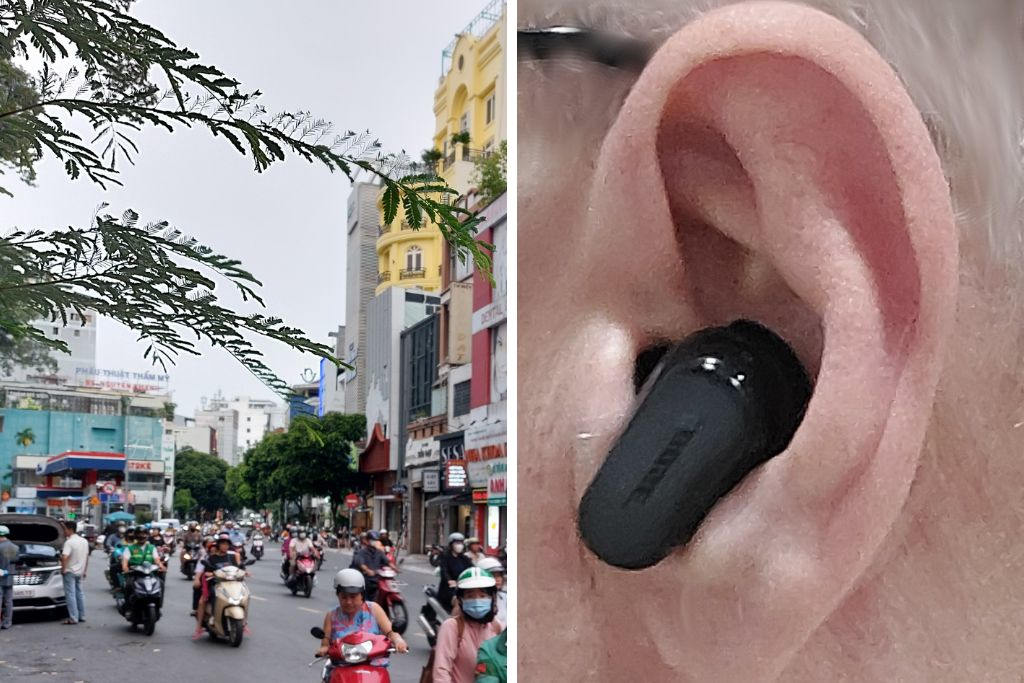
I spent a lot of time walking around vibrant, but also quite loud cities in the Philippines and Vietnam. This included busy roads, fast-food restaurants, shopping centers, trains, buses, airplanes, hotel rooms, public restrooms, etc.
On one hand, I enjoyed being out and about and the liveliness of it all. On the other hand, the loud noises—and in particular the traffic noise, including loud mufflers and screeching brakes—raised my stress levels considerably.
To get some relief, I started using the Bose QuietComfort Ultra Earbuds (2nd Gen) as an everyday noise reduction tool almost every day for several hours.
In Vietnam, it was the sheer number of mostly smaller motorbikes. In the Philippines, however, even lighter traffic along a small road can become overwhelming and stressful for me.
Why? Because many young riders modify the mufflers on their scooters and small motorcycles to make them sound louder and more powerful than the next guy’s. Note that most of these vehicles are only between 100 and 175 cc.
Take a listen to this early-evening city street noise sample from the Philippines (I suggest starting at a moderate volume):
https://earo-plugs-shop.com/wp-content/uploads/2025/12/phil-city-street-noise-01a.mp3%3C/a%3E%3C/audio%3E
So what did I do amidst that noise?
I put in my QC Earbuds Ultra 2 and set them to “Aware” with activated “Active Sense,” a transparency mode that attempts to counter loud environmental noise.
This made all the difference to my stress levels: when the earbuds detected the noises you just heard, they dynamically increased the level of noise reduction to counter these noise events. When the street became quieter, I could hear everything at a normal volume again.
Overall, Active Sense worked very well against these noises: the mufflers, the screeching, the approaching ambulance, and the honking.
I have had both predecessors to these earbuds, the QC Earbuds II (review ) and the QC Earbuds Ultra (1st Gen). I like both a lot and have used them extensively. The Bose QC Earbuds Ultra 2 bring only incremental improvements compared to the first generation, but that’s because the first generation was already very good at what it does.
The QC Earbuds Ultra 2 (like their predecessors) offer a multitude of adjustable noise reduction modes that in principle could make them an ideal noise reduction tool for what I might experience while traveling and walking around loud cities:
A strong, fixed max ANC mode (Quiet mode) for situations where I want to make everything as quiet as possible, such as when watching a movie or sleeping on an airplane or napping or just reading in a coffeeshop.
A transparency mode (Aware) with an optional toggle (Active Sense) to automatically detect and adapt to louder noises on the fly. I have found this mode very handy to remain in contact with my environment, for example while walking along busy city roads or shopping centers, or having a meal at a mall’s food court.Adjustable, fixed noise reduction modes that can be adjusted in their strength and are accessible via a long-tap on the earbuds themselves. There is no need to get out the phone and tinker with an app when you want to change the noise reduction.
What makes Bose’s Active Sense and its adjustable noise reduction modes particularly effective is that in both modes ANC strength and microphone sensitivity are adjusted simultaneously! That way both the earbuds and you can truly control environmental volume, not just change ANC modes.
Earbud-accessible favorite noise reduction modes:
I have gotten so used to this feature and find it almost indispensable.as favorites and toggle between them with a long-tap directly on the earbuds! That way you don’t need to pull out your phone at all!Note: From time to time I experiment with noise reduction levels and favorites.
Your requirements may be different or evolving.
Active Sense is an adaptive transparency mode that lets you hear almost as you would without earbuds, but with a noise guard watching out for you. When the earbuds detect louder noises, they increase the level of noise reduction across the frequency spectrum to counter that noise.
In a nutshell, they dynamically ramp up active noise cancellation and at the same time (!) decrease the sensitivity of the microphones that let you hear your environment. Upon cessation of a noise event, they gradually dial back noise reduction to let you hear everything at a normal volume again.
On the QC Earbuds Ultra 2, this has been remarkably well implemented!
It may sound easy, but devising an “automatically adjusting environmental volume knob” that works across the frequency spectrum is quite a challenge.
(Adaptive ANC alone—automatically adjusting active noise cancellation strength—won’t do that because ANC is generally only effective against part of the frequency spectrum, specifically low and lower mid frequency noise.)
At which noise level does Active Sense make a difference?
To explore at which noise level Active Sense starts making a difference, I used a hairdryer, which I measured at 78 dBA at a distance of one meter. Despite being in Aware mode, the earbuds very effectively reduced this noise.
Next I increased the distance until I couldn’t sense any noise reduction anymore. At 70 dBA, the hairdryer noise was still markedly reduced, while at 65 dBA, toggling between Active Sense on and off made no difference.
So from somewhere between 65 and 70 dBA, the earbuds started reducing noise.
I think this is a good threshold for getting full transparency in normally loud environments while being effective against bothersome noise.
As you get closer to the hair dryer, the earbuds progressively ramp up the noise reduction as mentioned before, and as you get further away, they decrease it again until you hear everything at a normal volume.
Loud city noise: heavy traffic, honking, ambulances (up to 80 dBA, loud mufflers up to 90 dBA, ambulances up to 95 dBA)
Active Sense worked very well when walking along roads with heavy traffic. This is actually my favorite use case for Aware mode with Active Sense enabled.
When I measured, typical heavy traffic seldom exceeded 75 to 80 decibels. That, however, is already plenty loud and Active Sense reduced that noise. As the traffic subsided, e.g., due to a traffic light turning red, I could hear my surroundings normally again.
Scooters with modified exhausts, tricycles, and jeepneys hit up to 86 and at times even close to 90 decibels. Their “noise blasts” too were cut down by a lot, making them much more tolerable.
Approaching ambulances progressively got louder, but with the earbuds in my ears they remained bearable. Active Sense increased the ANC level and decreased mic sensitivity, and at some point completely disabled the mics. As ambulances passed by, I measured up to 95 dBA.
Likewise, as I walked by a blaring PA speaker in front of a store, Active Sense ramped up the noise reduction to maximum ANC and piped in no more sound via its microphones. I only noticed how loud the music actually was when I took out one earbud.
Train station platform (no noise measurements taken)
Active Sense automatically reduced the noise of incoming trains. This too worked well and allowed me to still have a chat with other people.
As expected, Quiet mode was even more effective. Very quiet, but I also felt more isolated, which you may or may not like.
On a diesel train (ca 60 to 64 dBA)
Not excessively loud, but dominated by unnerving low frequency noise.
Here I ended up using Quiet mode, which almost completely eliminated the noise and let me listen to music in peace.
Hair dryers and hand dryers in public restrooms (ca. 70 to 80 dBA)
Active Sense dealt with both of these well.
Coffeeshop packed with students (65 to 75 dBA, dominated by low and mid frequency noise)
When I entered the place it was still pretty empty, but it didn’t remain that way for long. It was apparently a popular spot for students during their lunch break.
There was lots of chatter, plus music from the sound system and videos playing from people’s phones without earbuds. Aware with Active Sense made a substantial difference compared to full transparency, allowing me to stay connected while dampening the excesses.
Ultimately, I settled on a customized ANC mode three steps below maximum, which consistently made everything quieter but still allowed me to take in the vibrancy of this loud café.
Quiet mode (max ANC) dampened the noise, including the chatter, by a lot more. I would use Quiet for keeping focus while reading or writing.
Note: I usually have three different ANC modes (Quiet [max noise reduction], Aware with Active Sense, and Walk [three steps below maximum]) assigned as favorites, which allows me to toggle between them by long-tapping either earbud to suit my use case.
Shopping mall (72 to 80 dBA)
Peaks can be quite a bit higher than 80 decibels: screeching, crying, shouting, music.
Active Sense worked well as I walked through the mall and had a meal at the packed food court. I even had a good chat with another patron at the same table with the earbuds in.
(And, in the bathroom the hand dryer posed no problem.)
Alternatively, a moderate, fixed ANC setting (level 4 out of 10) worked as well.
Regardless of whether I chose Aware or a fixed ANC setting, the external microphones appeared to completely shut off when someone next to me suddenly shouted or rubber soles made a screeching noise on the polished tiled floor.
As I walked through the mall, there was occasionally a slight crackling, which I believe was related to electrical interference.
Loud fast food restaurant (70 to 75 dBA, with louder peaks)
Loud HVAC, loud chatter, and music were all effectively toned down.
Active Sense quite effectively adapted to increases in music volume or loud chatter eruptions.
Alternatively, a moderate, fixed ANC setting (level 4/10) worked as well.
On an airplane
Quiet mode beautifully reduced the cabin noise, which is what I used most of the time. Switching to Aware with Active Sense led to a slightly lower ANC setting but made it easier to talk to cabin crew.
On a plane, my best over-ear ANC headphones tend to reduce noise somewhat more effectively, but the earbuds were very good already.
On this trip I didn’t take over-ear headphones with me. I traveled lighter and only brought the tool I would also want to use outside in a hot climate.
The main downside of the earbuds on long plane travel is the limited battery life of about 6 hours. Putting the buds in the case for a quick recharge as I went to the bathroom worked well enough.
Napping in a relatively quiet hotel
During afternoon naps, I have found Quiet mode to be very valuable.
In this case, it was about protection from unpredictable interruptions like passing trucks, doors closing in the hallway, or sudden voices that would otherwise jolt me awake.
And, unfortunately, my naps are usually finished after one or two sudden noise events! For napping, only Quiet mode makes sense—you want maximum isolation, not environmental awareness.
What worked particularly well was combining Quiet mode with a waterfall sound played at a moderate volume. This combination eliminated virtually all sudden noises, with the waterfall masking whatever the ANC didn’t completely block.
Overall, I have found the Bose QC Earbuds Ultra 2 to work well in all these scenarios.
They are a very versatile and comfortable noise reduction tool.
The ear tips are long-lasting and the XL size fits my ears well. With many earbuds, I struggle to find tips large enough for my ears, but not with these.
Note: the ear tips come in 5 sizes: S, M, and L are in the box, and XS and XL in an optional ‘alternate sizing kit’ (Bose calls it that). From prior experience I knew L would be on the small side for me, so I requested the alternate sizing kit from Bose’s customer support.
I have found the fit stable when walking. However, I can’t use the earbuds for running.
How does this compare to using noise sensitivity earplugs in a loud city, or a busy restaurant, or the mall?
These earbuds adapt to different noise situations, as well as sudden changes in the environment in a way passive earplugs simply can’t.
You get to hear your environment when there is little noise and you get an automatic environmental volume knob that responds to disturbing noises in real time.
As mentioned earlier, the volume slider simultaneously adjusts both ANC strength and microphone sensitivity to control environmental volume. It doesn’t just tweak the ANC strength.
Other notable differences compared to noise sensitivity earplugs:
In most situations I prefer these earbuds, but noise sensitivity earplugs definitely still have their place in my repertoire. They are more discreet—and usable where earbuds wouldn’t be permitted—and many of them work just fine as a constant moderate noise reduction tool at an economical price. I like having both.
Also, the QC Earbuds are not rated hearing protectors (don’t use them for that!). While they can be more effective and adaptable against everyday noise than most noise sensitivity earplugs, in terms of noise reduction, they don’t outperform well-inserted high-NRR foam earplugs.
This is my experience using the Bose QC Earbuds Ultra (2nd Gen) as an everyday noise reduction companion, not a comprehensive review.
But how do they sound? I think they sound great, and I use them frequently for music listening.