I have lived in quite a few apartments and stayed in countless hotel rooms where traffic noise was waking me up several times a night.
Over time, I have developed a good understanding of what works to block out enough noise to help me fall and stay asleep.
Whether you have traffic noise keeping you awake at night or are a shift worker who has to sleep during the noisiest hours, this post is for you.
The two best tool sets I have found to block out traffic noise while sleeping are the following:
Foam earplugs + mid-pitch white noise to boost earplug performance
Active noise cancelling headphones + shaped white noise to boost headphones performance
When I stay somewhere and traffic noise becomes a problem (e.g., city apartment or hotel room), I use both tool combinations regularly.
At night I am mostly a side sleeper, which makes foam earplugs my first choice.
But, I have also gotten in the habit of afternoon napping, and I almost always nap lying on my back—wearing active noise cancelling headphones and playing white noise.
What frequencies is traffic noise made of?
To understand why I use these tool combinations and how to optimize them, let’s take a look at what traffic noise is actually composed of.
A while ago, I recorded about an hour of noise bleeding into my bedroom and then looked at the frequencies of individual noise events.
The apartment is in a small alley about 50 ft. from a main road with traffic going on day and night (a lot less but still). Close to the alley entrance is an intersection with traffic lights, so every couple of minutes vehicles stop and then start again.
I measured the bedroom background noise level at 30 decibels (dBA), which is reasonably quiet.
Individual noise events, however, reach 50 dB at certain frequencies and at times even >60 dB.
And herein lies the problem: everything is relatively quiet, and then you have trucks, cars and motorbikes revving up their engines, random honking, screeching brakes etc.
I analyzed about 20 minutes of my recordings in detail, identified individual noise events that stood out and looked at their dominant frequencies.
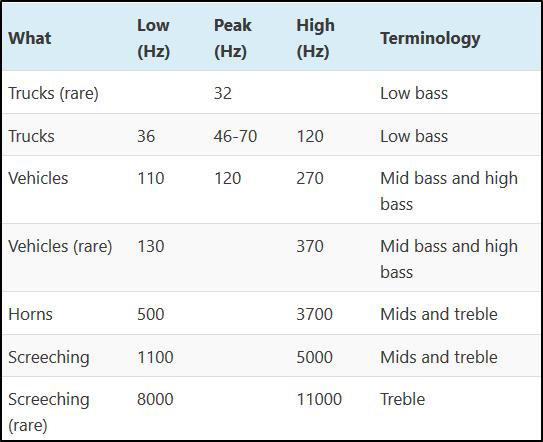
In the following table, I have subsumed and categorized individual noise events to make it easier to look at frequency ranges:
Now, all of these were noises that stood out and bothered me.
The most prevalent and annoying noise sources were the low-bass trucks, which at times caused building resonances, and the various mid-frequency vehicle horns that just came out of nowhere and startled me.
This table holds the key as to how my noise blocking tools help me against traffic noise and how I optimize them.
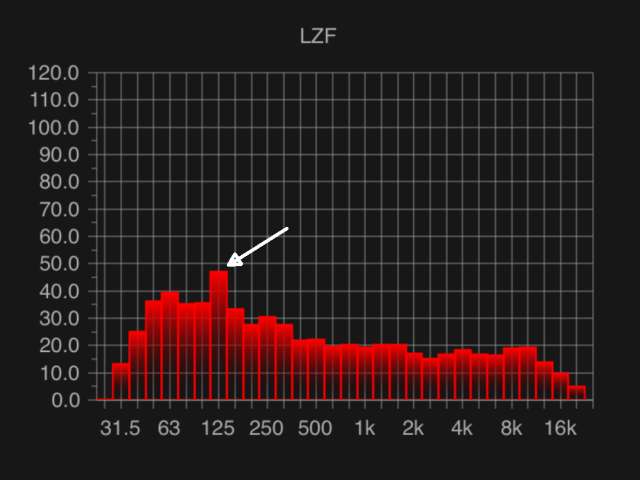
In the chart below you can see one individual noise event (at night).
Notice how at most frequencies the noise level is really low and then there is a certain range that goes up. The peak (125 Hz) is at 50 dB, while the overall noise level is 32 dBA (pushed up to this level by the peak).